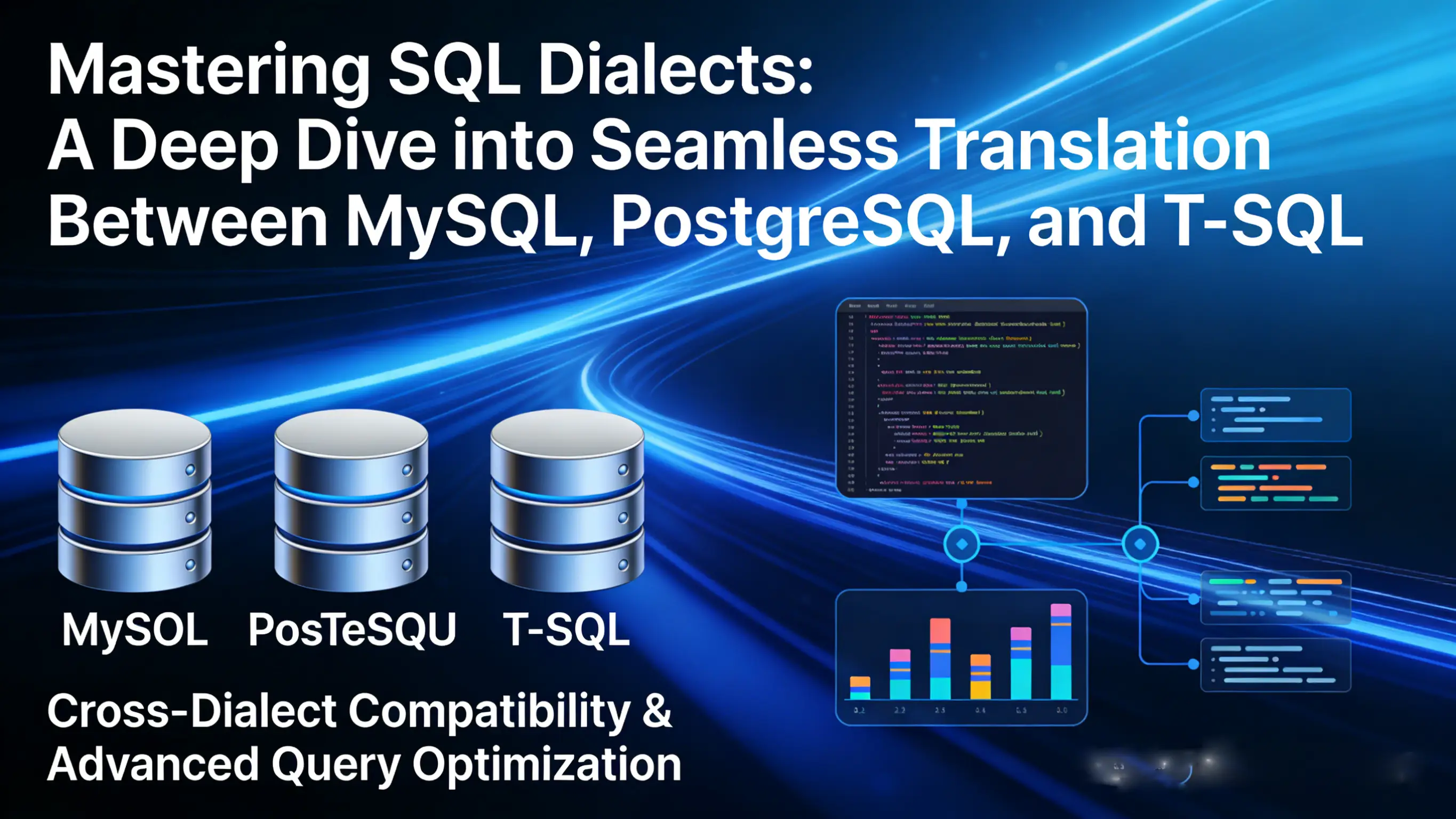
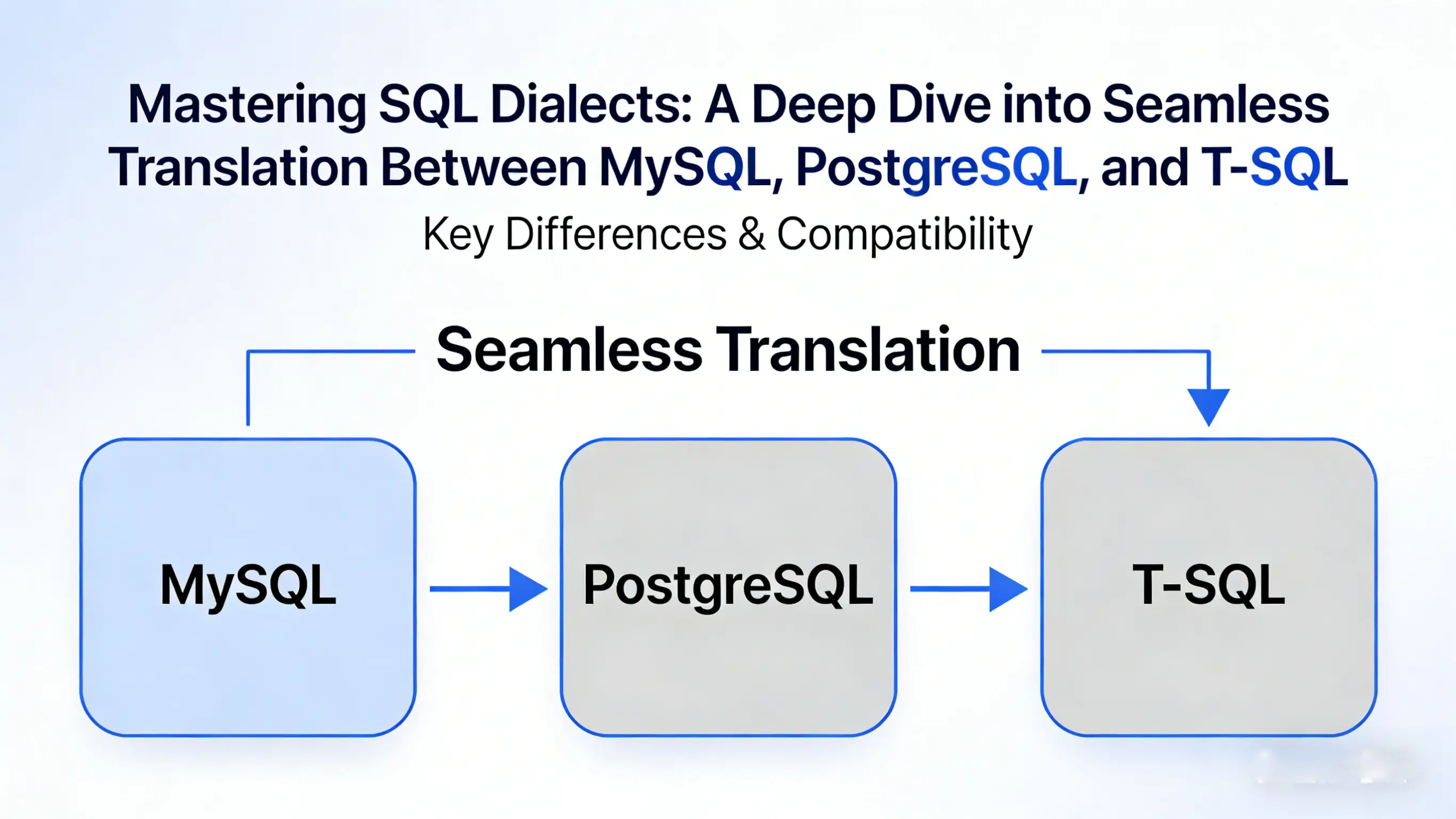
Mastering SQL Dialects: A Deep Dive into Seamless Translation Between MySQL, PostgreSQL, and T-SQL
The "Tower of Babel" in Modern Data Stacks
In an ideal world, SQL would be a universal language. You would write a query once, and it would run perfectly on MySQL, PostgreSQL, SQL Server, and Oracle. But in reality, database vendors have diverged significantly over the decades. A simple task like "select the first 10 rows" requires entirely different syntax depending on where you are running it.
For full-stack developers and data engineers, this is a daily struggle. You might develop locally on SQLite, deploy to production on PostgreSQL, and run analytics on a Snowflake or T-SQL data warehouse. Manually rewriting queries isn't just tedious—it's a minefield of syntax errors.
Common Dialect Pitfalls: More Than Just Keywords
The differences go deeper than just function names. Let's look at three common scenarios that trip up even experienced developers:
| Feature | MySQL | PostgreSQL | T-SQL (SQL Server) |
|---|---|---|---|
| Pagination | LIMIT 10 |
LIMIT 10 |
TOP 10 (at start) |
| String Concat | CONCAT(a, b) |
a || b |
a + b |
| Quoting | Backticks (`) | Double Quotes (") | Brackets ([ ]) |
| Date Math | DATE_ADD(d, INTERVAL 1 DAY) |
d + INTERVAL '1 day' |
DATEADD(day, 1, d) |
The Hidden Complexity of JOIN Syntax
While standard INNER JOIN and LEFT JOIN work across most platforms, the behavior of implicit joins and specific join types can vary dramatically.
Implicit vs. Explicit Joins
Old-school SQL developers often use comma-separated tables in the FROM clause (e.g., FROM users, orders WHERE users.id = orders.user_id). While MySQL handles this leniently, PostgreSQL's query optimizer treats this as a cross-join if the WHERE clause is ambiguous, leading to massive performance degradation. T-SQL deprecated this syntax years ago.
Our formatter automatically detects these implicit joins and can help you rewrite them into standard ANSI SQL-92 explicit JOIN syntax, which is safer, more readable, and easier to debug.
Handling NULL Values Across Databases
Perhaps the most frustrating aspect of SQL migration is how different engines handle NULL.
- MySQL: Uses
IFNULL(expression, alt_value). It also has a non-standard behavior where''(empty string) andNULLare treated differently but sometimes coerced. - PostgreSQL: Strictly adheres to the standard. Use
COALESCE(expression, alt_value). It distinguishes rigidly between an empty string and a null value. - SQL Server: Uses
ISNULL(expression, alt_value). Note thatISNULLin T-SQL takes only two arguments, whereasCOALESCEcan take multiple. - Oracle: The infamous
NVLfunction. Also, Oracle treats empty strings asNULL, which is a unique quirk that breaks many migrated applications.
When you use the Techory SQL Translator, we attempt to map these functions to their nearest equivalent. However, we always recommend reviewing logic that relies heavily on NULL handling, as the underlying behavior of the engine itself cannot be fully emulated by syntax translation alone.
Case Sensitivity: The Silent Killer
You wrote your app on a Mac (case-insensitive file system) using MySQL (default case-insensitive table names). You deploy to a Linux server running PostgreSQL (case-sensitive identifiers if quoted). Suddenly, your app crashes saying Table "Users" does not exist.
MySQL typically stores table names in lowercase on Linux. PostgreSQL folds unquoted identifiers to lowercase but preserves case for quoted ones. SQL Server depends on the database collation setting.
Our tool helps you standardize this. By choosing a "Target Dialect," you can enforce consistent quoting rules. For example, translating to PostgreSQL will automatically wrap mixed-case identifiers in double quotes ("Users"), ensuring that your query targets the exact object you intended.
Why "Find and Replace" is Not Enough
Many developers try to solve this with Regular Expressions (Regex) or simple text replacement. This is dangerous. Imagine trying to replace all instances of "User" (table name) with "Users". A simple replace might accidentally change a column named "User_Id" or a text string 'User not found'.
Context matters. This is where AST (Abstract Syntax Tree) parsing comes in. Our tool doesn't just read text; it understands the structure of your SQL code. It knows that "User" in a FROM clause is a table, but 'User' in a SELECT list is a string literal. It parses the code into a tree, transforms the tree to the target dialect, and then regenerates the SQL. This ensures 100% syntactic correctness.
Performance: Why Translation Isn't Free
While we focus on syntax correctness, developers must also consider performance. A query optimized for MySQL's nested-loop join algorithm might perform poorly on PostgreSQL's hash join or merge join strategies.
For example, MySQL developers often rely on GROUP BY to implicitly sort results (a deprecated behavior). PostgreSQL requires an explicit ORDER BY. If you migrate a query without adding the sort, your data might come back in a random order. Our tool highlights these potential semantic differences, encouraging you to write explicit, standard-compliant SQL that performs predictably on any platform.
Best Practices for Cross-Database Development
- Stick to ANSI SQL: Whenever possible, use standard syntax (e.g.,
CASE WHENinstead ofIF(), standardJOINs). - Avoid Proprietary Types: Arrays in Postgres, XML in SQL Server, or ENUMs in MySQL are hard to migrate. Use standard
VARCHARor join tables where possible if portability is a goal. - Use an ORM... Wisely: ORMs like Prisma or TypeORM handle much of this for you, but raw SQL is often necessary for performance. Use our formatter to keep your raw SQL chunks clean and readable.
- Test on the Target: Syntax translation is the first step. Always run
EXPLAIN ANALYZEon your target database to ensure the query plan is efficient.
Why Techory is Your Best Choice
We built this SQL Formatter & Translator to be the ultimate utility for the modern data professional. Here is why it stands out:
- Client-Side Security: Just like our other tools, your SQL queries never leave your browser. This is critical when working with production schemas or proprietary business logic.
- Intelligent Swapping: Working on a migration? Use our "Swap" feature to instantly reverse the translation direction (e.g., T-SQL to Postgres and back) to verify logic consistency.
- Real-time Validation: The tool catches syntax errors as you type. If you try to use a MySQL-specific function in a PostgreSQL context, it will alert you before you even try to run it.
Frequently Asked Questions (FAQ)
Does it support Stored Procedures?
Yes, we support PL/SQL and T-SQL procedural blocks (BEGIN/END, IF/ELSE), though complex logic migration should always be manually reviewed as procedural dialects differ significantly in error handling and variable scoping.
Can I format minified SQL?
Absolutely. Paste a single-line minified query, and our tool will pretty-print it with proper indentation, uppercased keywords, and clear structure.
Is the translation 100% accurate?
We handle 95% of standard SQL and common dialect features. However, proprietary extensions (like Oracle's specialized geospatial functions or Postgres's JSONB operators) may not have direct equivalents in other languages. In these cases, we preserve the original logic or provide a best-effort translation.
Conclusion
Mastering SQL dialects doesn't mean memorizing every syntax variation. It means having the right tools to bridge the gap. With the Techory SQL Translator, you can focus on the logic of your data, not the grammar of your database.
Start translating your queries today and experience the freedom of database agnosticism.